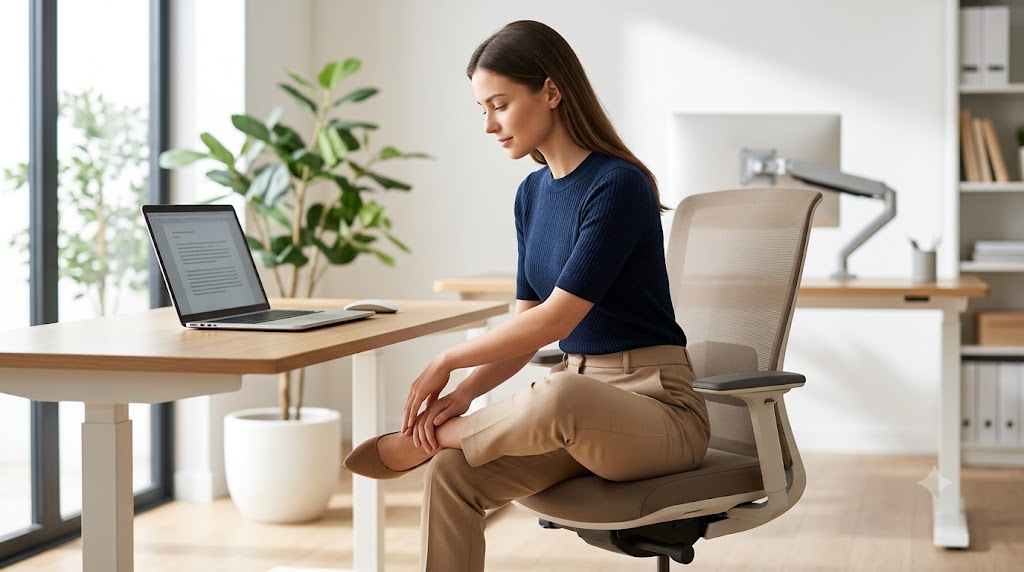
In today’s fast-paced corporate world, spending eight to ten hours glued to a computer screen has become the norm. While technology has made our jobs easier, it has taken a severe toll on our physical and mental health. Long hours of sitting lead to poor posture, chronic back pain, tight hips, and overwhelming stress. The solution doesn’t necessarily require a gym membership or an hour-long workout. The most effective, time-efficient answer lies in integrating Chair Yoga for Desk Workers into your daily routine.
This comprehensive guide will walk you through everything you need to know about relieving workplace stiffness, improving your posture, and maintaining high energy levels using a simple Office Desk Stretch protocol.
Why Sitting is the New Smoking: The Corporate Health Crisis

Before diving into the exercises, it is crucial to understand why your body aches after a long day at work. Human bodies were designed for movement, not for remaining static in an ergonomic office chair for prolonged periods.
When you sit for extended periods:
- Spinal Compression: Your lower back bears the brunt of your upper body weight.
- Hip Flexor Shortening: The front of your hips remains in a contracted position, leading to stiffness.
- Shoulder Slouching: Typing on a keyboard naturally pulls your shoulders forward, creating a “hunchback” posture.
- Decreased Blood Circulation: Lack of movement slows down blood flow, leading to fatigue and brain fog.
This is exactly where Chair Yoga for Desk Workers comes to the rescue. It allows you to counteract the negative effects of prolonged sitting without ever having to leave your workstation.
What is Chair Yoga?
Chair yoga is an adapted form of traditional yoga that makes poses accessible to everyone by using a chair for support. It is a gentle yet highly effective practice. For corporate professionals, it serves as the ultimate micro-workout. By incorporating an Office Desk Stretch during your short breaks, you can reset your nervous system and realign your spine.
Text Diagram: The Perfect Ergonomic Posture
To get the most out of your exercises, your baseline sitting posture must be correct. Here is a text-based visual map of how you should sit at your desk:
Plaintext
[ Head ]       -> Straight, ears aligned with shoulders. Screen at eye level.
   |
[ Shoulders ]  -> Relaxed, rolled back and down. Not hunched near ears.
   |
[ Spine ]      -> Neutral curve. Lower back supported by chair lumbar support.
   |
[ Arms ]       -> Elbows bent at a 90-degree angle. Wrists straight.
   |
[ Hips ]       -> Pushed to the back of the chair. Thighs parallel to the floor.
   |
[ Knees ]      -> Bent at 90 degrees.
   |
[ Feet ]       -> Flat on the ground. (Use a footrest if necessary).
Top 10 Exercises: The Essential Office Desk Stretch Routine
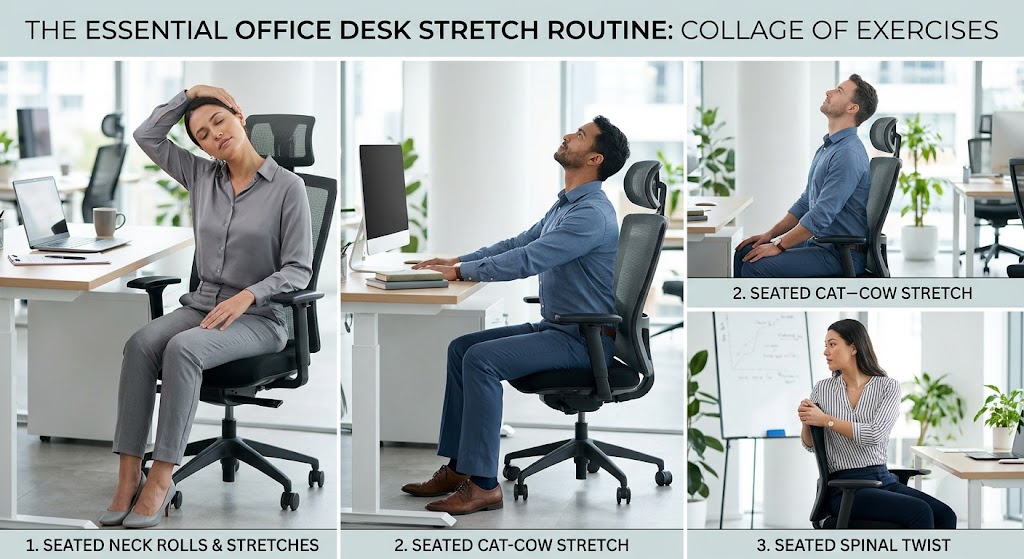
Below is a carefully curated sequence of exercises. You do not need any special equipment or athletic wear to perform these. You can do this entire Chair Yoga for Desk Workers routine in your regular work clothes.
1. Seated Neck Rolls and Stretches
Target Area: Neck and Upper Shoulders
- How to do it: Sit up straight with your feet flat on the floor. Gently drop your right ear toward your right shoulder. Hold for 5 deep breaths. Slowly roll your chin to your chest, and then bring your left ear to your left shoulder.
- Benefits: This simple Office Desk Stretch relieves tension headaches and neck stiffness caused by staring at monitors.
2. Seated Cat-Cow Stretch
Target Area: Spine and Core
- How to do it: Keep your hands resting on your thighs. As you inhale, arch your back, roll your shoulders back, and look up toward the ceiling (Cow pose). As you exhale, round your spine, drop your chin to your chest, and pull your belly button inward (Cat pose).
- Benefits: One of the best movements in Chair Yoga for Desk Workers, this pose lubricates the spine and prevents mid-day lower back pain.
3. Desk Chaturanga (Seated Push-Up)
Target Area: Arms, Chest, and Shoulders
- How to do it: Place your hands firmly on the edge of your sturdy desk, shoulder-width apart. Step your feet back so your body is on a slight diagonal. Inhale as you lower your chest toward the desk, keeping elbows hugged close to your ribs. Exhale to push back up.
- Benefits: Strengthens the upper body and counteracts the forward-leaning typing posture.
4. Seated Pigeon Pose
Target Area: Hips and Glutes
- How to do it: Sit at the edge of your chair. Cross your right ankle over your left knee, keeping your right foot flexed. Sit up tall, and if you need a deeper stretch, gently hinge forward from your hips (not your waist) while keeping your spine straight.
- Benefits: A profound Office Desk Stretch that releases deep sciatic nerve tension and opens tight hips.
5. Seated Spinal Twist
Target Area: Entire back and digestive organs
- How to do it: Sit sideways in your chair so the backrest is to your right. Plant your feet flat on the ground. Twist your torso to the right, holding onto the backrest of the chair with both hands to gently deepen the twist. Hold for 5 breaths, then switch sides.
- Benefits: This staple of Chair Yoga for Desk Workers detoxifies internal organs and restores spinal mobility.
6. Wrist and Finger Stretches
Target Area: Forearms, Wrists, and Hands
- How to do it: Extend your right arm in front of you with the palm facing up. Use your left hand to gently pull the right fingers downward toward the floor. Hold for 15 seconds. Then, point the fingers down and press the back of the hand toward you.
- Benefits: Crucial for preventing Carpal Tunnel Syndrome and repetitive strain injuries from heavy mouse and keyboard usage.
7. The Eagle Arms Stretch
Target Area: Upper Back and Shoulders
- How to do it: Stretch your arms straight out in front of you. Cross your right arm over your left, bend your elbows, and bring your palms to touch (or as close as they can get). Lift your elbows up to shoulder height and pull your hands away from your face.
- Benefits: An intense Office Desk Stretch that targets the rhomboids and trapezoid muscles—the exact spot where stress tends to accumulate.
8. Seated Forward Fold
Target Area: Lower Back and Hamstrings
- How to do it: Push your chair slightly away from the desk. Sit on the edge with your feet wider than your hips. Exhale and slowly fold your torso forward, letting your chest rest between your thighs and your hands drop to the floor. Relax your neck completely.
- Benefits: Inversions calm the nervous system. This specific movement in Chair Yoga for Desk Workers increases blood flow to the brain, providing an instant energy boost.
9. High Altar Pose
Target Area: Shoulders and Side Body
- How to do it: Inhale and raise your arms up toward the ceiling. Interlace your fingers and invert your palms so they face upward. Lean gently to the right, hold for a breath, then lean gently to the left.
- Benefits: Expands the ribcage, allowing for deeper breathing and better lung capacity throughout the workday.
10. Seated Savasana (Mindful Rest)
Target Area: Nervous System and Mental State
- How to do it: Sit back completely in your chair. Rest your hands on your lap, palms facing up. Close your eyes and focus entirely on the sensation of your breath entering and leaving your nose. Do this for 2-3 minutes.
- Benefits: The ultimate mental reset. This concludes your Office Desk Stretch routine, leaving you focused, calm, and ready to tackle the rest of your tasks.
Creating a Daily Workplace Routine
Knowing the exercises is only half the battle; consistency is where the magic happens. You don’t need to do all ten poses at once. Instead, sprinkle them throughout your day.
The 3-Phase Approach for Maximum Productivity
| Time of Day | Goal | Recommended Routine |
| Morning (10:00 AM) | Wake up the body & prep the spine | Neck Rolls, High Altar Pose, Wrist Stretches. |
| Mid-Day (2:00 PM) | Fight the post-lunch energy slump | Cat-Cow Stretch, Seated Spinal Twist, Seated Pigeon. |
| Late Afternoon (4:30 PM) | Relieve accumulated stress before heading home | Eagle Arms Stretch, Seated Forward Fold, Seated Savasana. |
By breaking the routine into these smaller chunks, Chair Yoga for Desk Workers becomes an effortless habit rather than a daunting chore.
The Science of Breathing at Your Desk
You can perform every Office Desk Stretch perfectly, but if you are holding your breath, you will not reap the full benefits. Desk workers often suffer from “email apnea”—unconsciously holding their breath or breathing shallowly when reading stressful emails or focusing intensely on a screen.
How to fix this with Pranayama (Yogic Breathing):
- Belly Breathing (Diaphragmatic Breathing): Place one hand on your belly. Inhale deeply through your nose so that your belly pushes your hand out. Exhale slowly through your mouth, letting the belly fall. This signals to your brain that you are safe, lowering cortisol (stress hormone) levels.
- The 4-7-8 Technique: Inhale for 4 seconds, hold for 7 seconds, and exhale for 8 seconds. This is an incredibly powerful tool to use before a stressful presentation or meeting.
Incorporating breathwork elevates Chair Yoga for Desk Workers from a simple physical stretching routine to a comprehensive mind-body wellness protocol.
Ergonomics and Environment: Enhancing Your Yoga Practice
No amount of stretching can completely fix a terribly designed workspace. To ensure your Office Desk Stretch provides long-lasting relief, you must optimize your physical environment.
- Invest in a Good Chair: Ensure it has proper lumbar support. If not, roll up a towel and place it behind your lower back.
- Monitor Height: The top third of your monitor should be at eye level. If you are constantly looking down, you will strain your cervical spine.
- Lighting and Vision: Follow the 20-20-20 rule. Every 20 minutes, look at an object 20 feet away for 20 seconds. This acts as “yoga for the eyes.”
- Hydration: Keep a large bottle of water on your desk. Not only does water lubricate your joints, but the need to use the restroom forces you to stand up and walk around periodically!
Frequently Asked Questions (FAQs)
Q1: Will I sweat while doing these exercises at work?
A: Not at all. Chair Yoga for Desk Workers is designed to be low-impact. The goal is to stretch muscles and mobilize joints, not to raise your heart rate to the point of sweating. You can comfortably do these in a suit or formal wear.
Q2: How often should I take a break to stretch?
A: Ideally, you should perform a quick 2-to-3 minute Office Desk Stretch every 60 to 90 minutes. Setting a gentle alarm or using a desk-timer app can help you remember.
Q3: Can these exercises help with weight loss?
A: While Chair Yoga for Desk Workers burns slightly more calories than remaining completely static, it is not a weight-loss program. Its primary benefits are pain relief, posture correction, and mental clarity. However, by reducing stress (and thereby reducing cortisol), it can prevent stress-induced weight gain.
Q4: I have pre-existing back pain. Are these stretches safe?
A: Generally, yes. The movements are very gentle. However, if you have a herniated disc, severe sciatica, or any chronic medical condition, you should always consult with a physician or physical therapist before starting any new Office Desk Stretch program. Listen to your body—a stretch should feel like a satisfying release of tension, never a sharp pain.
Final Thoughts: Taking Control of Your Corporate Wellness
Your job should not cost you your physical well-being. By taking just a few minutes out of your busy schedule, you can drastically alter how your body feels at the end of the day. The beauty of this practice is its accessibility. You don’t need a yoga mat, you don’t need special clothing, and you don’t need a lot of time.
Start small. Tomorrow, commit to doing just three poses from this guide. Notice how your body responds. As you become more comfortable, gradually build up your routine.
Remember, an Office Desk Stretch is not a break from your productivity; it is an investment in your productivity. When you are pain-free and your mind is clear, you work faster, make better decisions, and enjoy your time at work significantly more. Embrace Chair Yoga for Desk Workers today, and take the first step towards a healthier, happier professional life.






1 thought on “Chair Yoga for Desk Workers: The Best Office Desk Stretch”