
We have all been there. It is 2:30 PM, your cursor is blinking on a blank screen, and you are staring at a complex problem that suddenly feels impossible to solve. You have had your second cup of coffee, you have splashed cold water on your face, and yet, the cognitive gears simply refuse to turn. You feel physically stuck, but more importantly, you are mentally paralyzed.
Most professionals try to power through this wall by forcing themselves to stare harder at the monitor. As an experienced wellness coach, I can tell you that this is the exact opposite of what your body and brain need. The secret to unlocking your cognitive potential doesn’t lie in another espresso shot; it lies in your spine. Utilizing chair yoga for mental clarity is one of the most effective, science-backed strategies to break through a mental block and restore your problem-solving abilities.
The Anatomy of a Mental Block: Why You Get “Stuck”
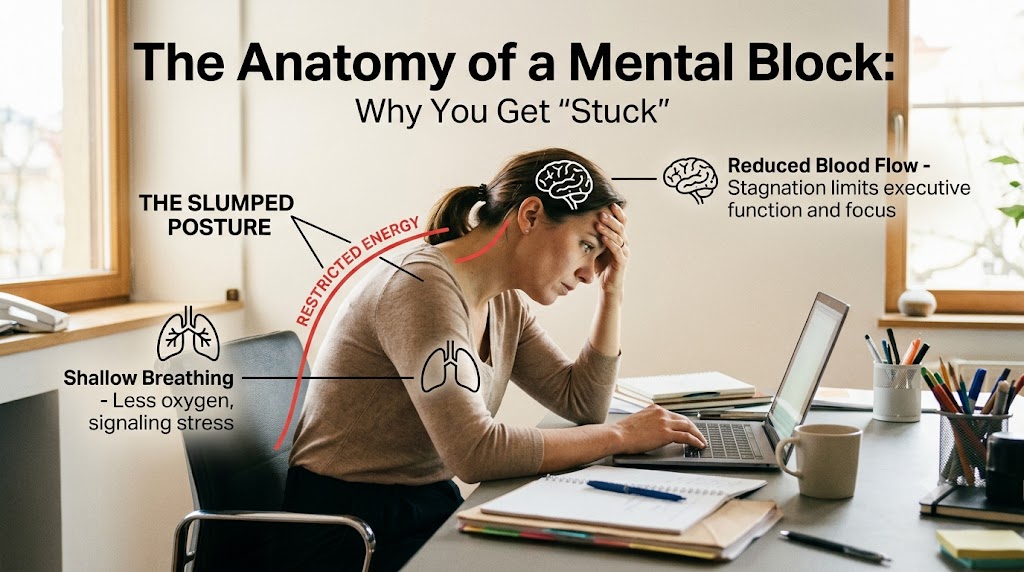
To understand why movement is the solution, we first need to understand the problem. When you sit at a desk for hours, your body naturally falls into a “slump.” Your shoulders round forward, your chest collapses, and your cervical spine (your neck) juts out toward your screen.
This posture does two very dangerous things to your productivity:
- It restricts breathing: A collapsed chest means your diaphragm cannot fully expand. Shallow breathing signals to your nervous system that you are in a state of low-grade stress, spiking cortisol levels and stifling the creative, problem-solving centers of your brain (the prefrontal cortex).
- It reduces blood flow: Prolonged sitting slows down circulation. Less blood pumping through your body means less oxygen reaching your brain. The result? That heavy, sluggish feeling we all know too well.
If you want to reduce brain fog, you have to change your physiology. You cannot solve a dynamic mental problem with a stagnant physical posture.
The Connection Between the Spine and the Brain
In yoga philosophy, the spine is considered the body’s central energy channel. In modern neuroscience, the spine houses the central nervous system, which is the superhighway communicating between your body and your brain.
When you introduce gentle, deliberate movement to the spine, you stimulate the vagus nerve, which helps shift your body out of the stressed “fight or flight” mode and into the “rest and digest” mode. One of the greatest spinal movement benefits is that it actively flushes stagnant cerebrospinal fluid, bringing a fresh supply of oxygenated blood directly to your brain.
When you practice chair yoga for mental clarity, you are literally hitting the physical reset button on your cognitive function. You are creating space in your body, which translates directly to creating space in your mind to break through a mental block.
Real-World Example: The Power of the Reset
Let’s look at a practical example. Consider a software developer named Rahul. He had been trying to debug a complex piece of code for three hours. His posture was rigid, his jaw was clenched, and his frustration was peaking. Instead of continuing to stare at the screen, Rahul pushed his chair back and spent just five minutes performing a series of seated yoga poses.
He focused on deep spinal twists and heart-opening stretches. By taking his eyes off the screen, expanding his lung capacity, and physically untying the knots in his back, he allowed his subconscious mind to take over. When he returned to his keyboard, the solution to the code error was glaringly obvious. The bug hadn’t changed; Rahul’s cognitive state had. This is the profound problem-solving power of mindful movement.
Actionable Tips for Practicing at Your Desk
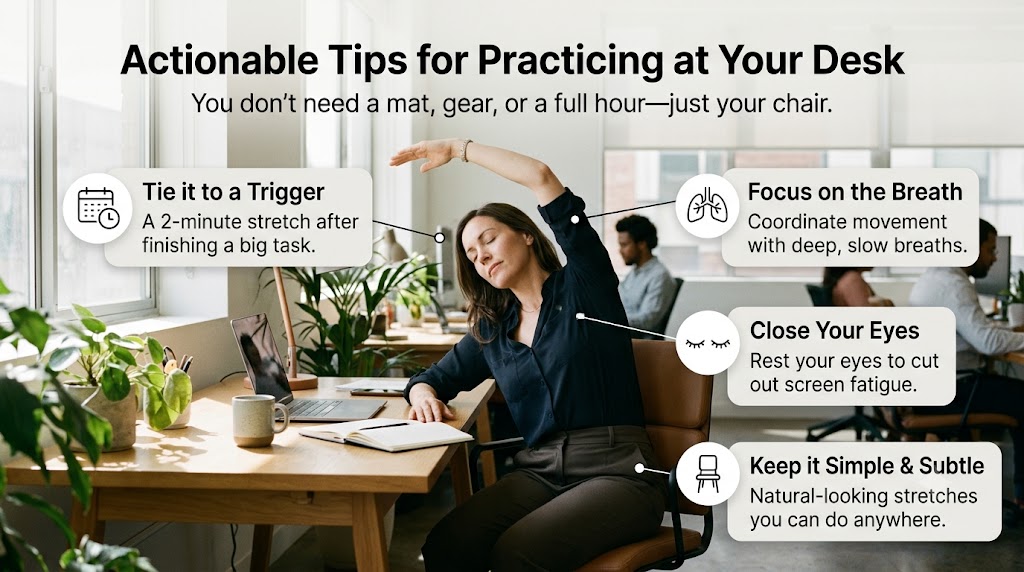
You do not need an expensive yoga mat, athletic wear, or a full hour to reap these benefits. You can effectively reduce brain fog right where you are sitting. Here are some experienced tips for integrating this practice into a busy workday:
- Tie it to a Trigger: Do not wait until you are completely burned out to move. Tie your practice to a daily habit. For example, every time you finish a major task or every time you hit “send” on an important email, do two minutes of seated yoga poses.
- Focus on the Breath: The physical movement is only half of the equation. As you stretch, synchronize your movements with deep, diaphragmatic breathing. Inhale to expand, exhale to twist or fold.
- Close Your Eyes: A massive part of office fatigue is visual overstimulation from blue light. Closing your eyes while you stretch removes visual input, giving your brain’s processing centers a desperately needed break.
- Do Not Worry About Looking Silly: A common barrier to office wellness is the fear of coworkers watching. The movements required to break through a mental block are subtle. A gentle neck roll or a seated twist looks perfectly natural in a professional setting.
The “Un-Slump” Sequence: 4 Steps to Solve Any Problem
When you hit a wall and need to access chair yoga for mental clarity, follow this simple, highly effective 10-minute sequence.
1. The Foundation: Seated Mountain Pose (Tadasana)
Before you move, you must align. Scoot to the edge of your chair so your back is not resting on the lumbar support. Place both feet flat on the floor, hip-width apart. Roll your shoulders up, back, and down. Imagine a string pulling the crown of your head toward the ceiling.
- Why it works: This immediately opens the chest cavity and aligns the spine, taking the pressure off your lower back and allowing for optimal oxygen intake.
2. The Awakening: Seated Cat-Cow (Marjaryasana-Bitilasana)
Place your hands on your knees. As you take a deep inhale, arch your back, pull your chest forward, and look slightly up toward the ceiling (Cow Pose). As you exhale, powerfully round your spine, tuck your chin to your chest, and pull your belly button toward your spine (Cat Pose). Repeat this for 5 to 10 fluid breath cycles.
- Why it works: This is where the spinal movement benefits truly shine. Flexing and extending the spine acts like a pump, moving cerebrospinal fluid and instantly helping to reduce brain fog.
3. The Perspective Shift: Seated Spinal Twist (Ardha Matsyendrasana)
Sit tall. Take a deep inhale. As you exhale, gently twist your torso to the right. Place your left hand on your right knee and your right hand on the back of your chair for support. Look over your right shoulder. Hold for 5 deep breaths, then switch to the left side.
- Why it works: Twists are incredibly detoxifying. They compress the digestive organs and then flood them with fresh blood upon release. Energetically, twisting forces you to look at the room from a different angle, which psychologically prepares you to look at your work problem from a new perspective.
4. The Surrender: Seated Forward Fold (Uttanasana)
Push your chair slightly away from your desk. Take a deep inhale to sit tall, and as you exhale, hinge at your hips and fold your torso over your thighs. Let your arms hang heavy toward the floor and allow your head and neck to completely relax. Nod your head “yes” and shake it “no” to release tension. Hold for 10 slow breaths.
- Why it works: Inversions (any pose where your head is below your heart) are the fastest way to physically deliver blood to the brain. This pose is the ultimate tool to break through a mental block, soothing the nervous system and resetting your mental state.
The Long-Term Impact on Your Career
Rethinking how we approach problem-solving is vital for long-term career success and mental health. We are culturally conditioned to believe that productivity equals stillness—that the person who sits at their desk the longest gets the most done. Science and biomechanics prove this is a fallacy.
By utilizing chair yoga for mental clarity, you are not taking a break from your work; you are engaging in a practice that enhances your work. Regular seated yoga poses prevent the chronic pain that leads to burnout, keep your executive function sharp, and ensure that when a difficult challenge arises, you have the neurological flexibility to solve it.
The next time you find yourself staring blankly at your monitor, remember that the answer isn’t on the screen. The answer requires you to shift your posture, deepen your breath, and move your body.
Frequently Asked Questions (FAQs)
Q: How often should I practice chair yoga during the workday? A: To consistently reduce brain fog and maintain high productivity, aim for a 3 to 5-minute movement break every 60 to 90 minutes. Consistency is much more important than duration.
Q: Can these stretches actually help me solve complex analytical problems? A: Yes. Analytical problem-solving requires high executive function in the prefrontal cortex. When you are stressed or slumped, your brain shifts resources to the amygdala (the survival center). The spinal movement benefits of yoga regulate your nervous system, allowing your brain to shift resources back to analytical thinking.
Q: Do I need prior yoga experience to do these poses? A: Not at all. Seated yoga poses are designed to be accessible to everyone, regardless of fitness level, age, or flexibility. The goal is mindful movement and breath, not physical perfection.
Q: I have a bad lower back. Is it safe to twist and fold in an office chair? A: Yes, but always listen to your body. Move slowly, and never push into sharp pain. The goal of chair yoga for mental clarity is to relieve tension, not create it. If a deep twist hurts, perform a micro-twist instead. Always consult with a physical therapist if you have diagnosed spinal issues.
Q: What is the single best pose to do if I only have one minute? A: The Seated Cat-Cow. It provides the most efficient physical and mental reset, quickly bringing blood flow to the brain to help you break through a mental block in under sixty seconds.