It’s 2:47 p.m. Your inbox has 34 unread emails, your neck feels like it’s made of rope, and your leg won’t stop bouncing under the desk. Sound familiar?
If you’ve ever felt your chest tighten right before a meeting, or caught yourself holding your breath while reading a stressful email, you already know that anxiety doesn’t wait for a “good time” to show up. It shows up mid-scroll, mid-deadline, mid-everything.
The good news? You don’t need a yoga mat, a quiet room, or even ten minutes away from your desk to calm your nervous system. Chair yoga for anxiety and stress relief is one of the simplest, most underrated tools for bringing yourself back from that jittery, overwhelmed feeling, and you can do it without ever leaving your chair.
This guide walks you through why anxiety builds up so easily during the workday, how chair yoga for stress and anxiety actually works, and a full 10-minute routine you can try right now, in your work clothes, without anyone in the next cubicle even noticing.
Why Anxiety Builds Up So Easily at Your Desk
Your body doesn’t know the difference between “my boss just messaged me” and “a tiger is chasing me.” Both trigger the same response: a flood of cortisol and adrenaline, a faster heartbeat, shallower breathing, and shoulders that creep up toward your ears.
Normally, that stress response is meant to pass through the body. You’d run, you’d move, and the hormones would clear out. But at a desk, there’s nowhere for that energy to go. You just sit there, tense, staring at a screen, for hours. This is exactly the gap chair yoga at work is built to fill.
A few things make this worse:
- Shallow breathing. Stress pulls your breath into your chest instead of your belly, which quietly signals to your brain that danger is still nearby.
- Poor posture. Hunching over a keyboard compresses the diaphragm, making deep breathing physically harder.
- Long stretches of stillness. Movement helps your body metabolize stress hormones. Sitting still lets them linger.
- Screen fatigue. Hours of staring at a monitor narrows your focus and can quietly heighten a sense of being trapped.
None of this is a character flaw. It’s biology. But it does mean the fix isn’t just “calm down.” It’s giving your body an actual, physical way to release what’s built up, which is exactly where desk yoga for stress comes in.
How Chair Yoga Actually Helps With Stress and Anxiety
Chair yoga at work isn’t about achieving a perfect pose or getting flexible. It works because it stacks three things that each calm the nervous system on their own, and together, they do it faster:
- Movement releases physical tension stored in the shoulders, neck, and hips.
- Breathwork activates the parasympathetic nervous system, your body’s “rest and digest” mode, which is the direct opposite of an anxious, wound-up state.
- Present-moment focus pulls your mind out of anxious future-thinking and back into your body, where you actually are.
That’s the whole idea behind chair yoga for anxiety and stress relief: it meets your body exactly where it already is, at your desk, mid-day, fully clothed. You don’t need to touch your toes. You just need about ten minutes and a chair that won’t roll away from you mid-stretch (ask me how I know that one).
I started building this habit during a stretch of back-to-back video calls that left me feeling, by 4 p.m., like I’d been holding my breath all day, because I basically had been. The first time I tried three slow shoulder rolls and a seated twist between meetings, it felt almost too small to matter. But my jaw unclenched. My shoulders dropped an inch. I walked into the next call without that tight, buzzing feeling sitting in my chest. That’s really what chair yoga for stress relief is: small, repeatable resets, not one dramatic fix.
The 10-Minute Chair Yoga Routine for Anxiety and Stress Relief
Sit toward the front edge of your chair, feet flat on the floor, hands resting on your thighs. Take one slow breath in, and let it out with a soft, audible sigh before you begin.
1. Seated Mountain Pose with Breath Awareness (1 minute)
Sit tall, spine long, shoulders relaxed away from your ears. Rest one hand on your chest and one on your belly. Inhale slowly through your nose for a count of four, feeling your belly hand rise more than your chest hand. Hold for two counts. Exhale slowly for six counts.
Why it helps: A longer exhale than inhale signals safety to your nervous system, and can start lowering your heart rate within a minute.
2. Seated Cat-Cow (1 minute)
Hands on your knees. Inhale as you arch your back, lifting your chest and letting your belly soften forward. Exhale as you round your spine, tucking your chin toward your chest. Repeat slowly for 6-8 rounds, moving with your breath.
Why it helps: Gently mobilizes a spine that’s been locked into a hunch over a keyboard for hours.
3. Seated Neck Rolls (1 minute)
Drop your right ear toward your right shoulder, then slowly roll your chin down and across to the left shoulder. Reverse. Go slowly here; there’s no prize for speed.
Why it helps: Anxiety tends to collect in the neck and jaw first. This releases both.
4. Seated Spinal Twist (1-2 minutes)
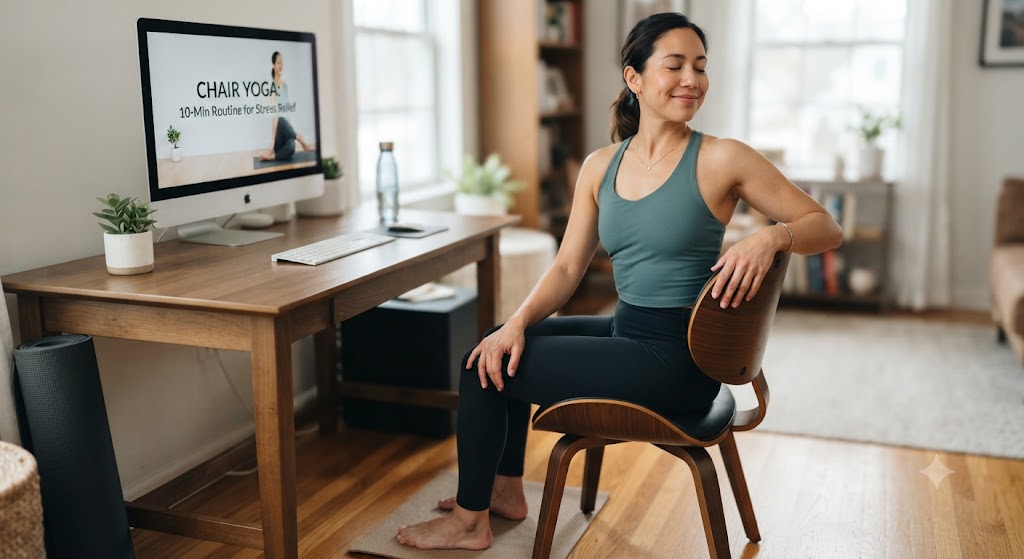
Sit tall. Place your right hand on the back of your chair and your left hand on your right knee. Gently twist your torso to the right, looking over your shoulder. Hold for 3-4 breaths, then switch sides.
Why it helps: Twists stimulate the vagus nerve, which plays a direct role in calming your body’s stress response.
5. Wrist and Finger Release (1 minute)
Extend both arms forward, palms up. Use one hand to gently pull the fingers of the other hand back, stretching the wrist. Then make loose fists and roll your wrists in slow circles, both directions.
Why it helps: Hours of typing quietly feed into overall body tension, and this is the release most people skip entirely.
6. Seated Forward Fold (1-2 minutes)
Walk your feet slightly wider than your hips. Hinge forward from your hips, letting your chest rest toward your thighs and your arms hang loosely. Let your head and neck go completely heavy.
Why it helps: Forward folds are naturally calming, they bring your head below your heart, which can ease both anxiety and racing thoughts.
7. Shoulder Rolls with Exhale Release (1 minute)
Inhale as you lift your shoulders up toward your ears. Exhale with an audible sigh as you drop them down and back. Repeat 5 times.
Why it helps: Vocalizing the exhale naturally slows and deepens your breath, more than a silent one does.
8. Closing Breath: 4-7-8 Technique (1-2 minutes)
Inhale quietly through your nose for 4 counts. Hold for 7 counts. Exhale completely through your mouth for 8 counts. desk yoga for stress Repeat 3-4 rounds.
Why it helps: This pattern is widely used to interrupt anxious spirals quickly, both by slowing the heart rate and giving your mind one specific thing to focus on.
When to Use This Routine
This kind of desk yoga for stress doesn’t need to wait for a crisis point:
- Right before a high-stakes meeting or presentation
- After a stressful email, so you’re not replying from a place of panic
- Mid-afternoon, when energy and patience both start to dip
- The moment you notice your shoulders creeping up toward your ears
- First thing in the morning, to set a calmer tone before your inbox opens
You don’t need all ten minutes every time. Even 90 seconds of slow breathing and a spinal twist between calls can genuinely shift how you feel, and chair yoga at work only ever takes as long as you actually have.
Motivation: Making Chair Yoga at Work an Actual Habit
The hardest part was never the poses. It’s remembering to do them. A few things that help:
- Attach it to something you already do. Right after you close your laptop for lunch, or right before you open your inbox in the morning.
- Keep expectations tiny. One minute of breathing still counts. You haven’t failed by skipping the full routine.
- Use a visual cue. A sticky note on chair yoga at work your monitor, a calendar reminder, or even a specific song. My own is embarrassingly simple: a sticky note on my monitor that just says “breathe.”
- Track it loosely. A tally mark on a notepad, not to optimize anything, just to notice the pattern.
- Forgive the skipped days. This desk yoga for stress works because of weeks of small repetition, not because of one perfect day.
Anxiety management isn’t about erasing stress completely. It’s about building small, reliable ways to bring your body back to baseline, again and again, for as long as you need to. That’s the quiet power of chair yoga for anxiety and stress relief: it doesn’t ask you to overhaul your day, just to borrow a few minutes from it.
Common Mistakes to Avoid
- Holding your breath during stretches. This defeats the entire purpose. Keep breathing slow and steady the whole way through.
- Rushing the routine. Three slow, deliberate movements will calm you more than ten rushed ones.
- Only using it once anxiety is already high. It works best as a regular practice, not just emergency damage control.
- Comparing your flexibility to “yoga people.” This was never about how deep your stretch goes. It’s about calming your nervous system.
FAQ
Does chair yoga actually help with anxiety, or is it just stretching?
It’s more than stretching. The combination of slow chair yoga at work movement, deep breathing, and present-moment focus directly engages your parasympathetic nervous system, the part of you responsible for calming back down. Chair yoga for anxiety and stress relief works best alongside other stress management tools, not as a replacement for professional support when anxiety is severe or persistent.
How long does a session need to be to make a difference?
Even 2-3 minutes of slow breathing and gentle movement can ease tension and lower your heart rate. The full 10-minute routine above is ideal, but a 90-second version between meetings genuinely helps too.
Can I do this in work clothes?
Yes. Chair yoga at work is designed to work in regular office wear, including button-downs, jeans, or fitted clothing. Nothing requires a bend that chair yoga at work would strain a seam.
Will people notice if I do this at my desk?
Most of it is subtle enough to pass as ordinary fidgeting, neck rolls, wrist stretches, and quiet breathing don’t draw attention. If you’re self-conscious, save the bigger stretches, like the forward fold, for a bathroom break or an empty meeting room.
Is chair yoga enough for severe anxiety or panic attacks?
Chair yoga is a supportive tool for everyday stress and mild-to-moderate anxiety. It isn’t a replacement for therapy or medical care. If anxiety is frequent, intense, or interfering with your daily life, please talk to a doctor or mental health professional alongside using tools like this.
Final Thoughts
You don’t need a retreat, a yoga mat, or a free hour to take care of your nervous system. Sometimes the most powerful reset is three slow breaths and a gentle twist, right there in your office chair.
Start small. Pick just one move from this routine, maybe the 4-7-8 breath, or the seated forward fold, and try it the next time you feel that familiar tightness creep into your shoulders. That’s really all desk yoga for stress ever asks of you: one small, doable minute at a time.
1 thought on “Chair Yoga for Anxiety and Stress Relief at Your Desk: A 10-Minute Routine That Actually Works”