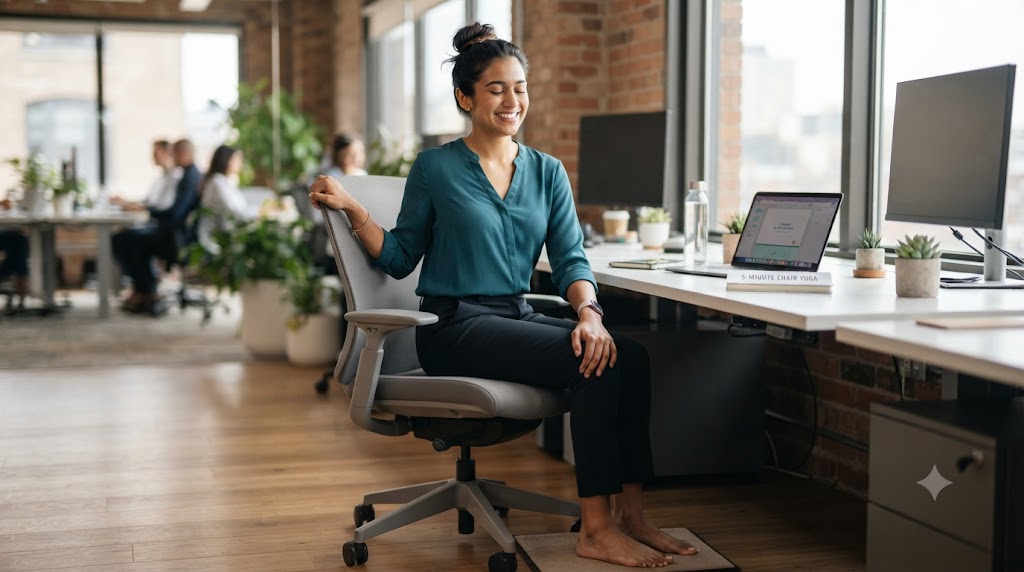
Do you ever find yourself staring at your computer screen around 3:00 PM, feeling like your brain has turned to mush, your shoulders are hitched up to your ears, and your lower back is screaming for mercy? I’ve been there more times than I can count. When work gets hectic, deadlines pile up, and your schedule is packed tighter than a commuter train, finding an hour for a gym session or a full yoga class feels next to impossible.
That exact struggle is why I started experimenting with micro-movements right at my workspace. Over the past few years, I’ve realized that you don’t need a fancy studio or a massive chunk of time to reset your body. What you actually need is a 5-minute quick chair yoga routine that you can seamlessly slip into your workday.
In this detailed guide, I am going to walk you through a practical, no-fluff approach to desk stretching. Whether you are managing a demanding 9-to-5 or just trying to stay limber while working from home, this routine will change how you feel throughout the day. Let’s dive deep into why this works, how to do it safely, and a step-by-step flow you can start using today.
Why Desk Workers Need a 5-Minute Quick Chair Yoga Routine
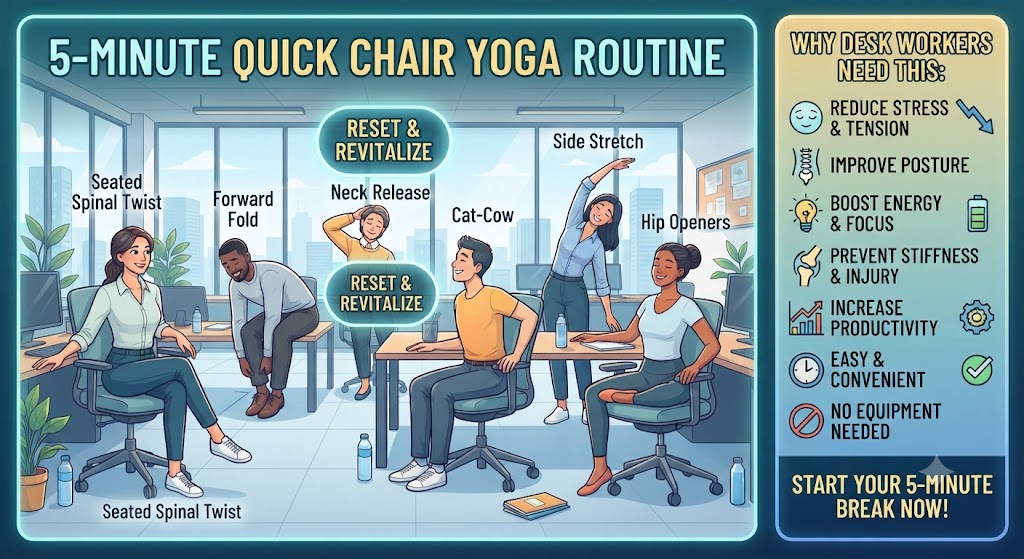
Let’s be honest with ourselves: sitting for eight to ten hours a day is an absolute trap for human anatomy. When we sit hunched over a keyboard, our hip flexors shorten, our chest collapses inward, and our neck strains forward to peer at the monitor.
I used to think that a heavy weekend workout would completely cancel out a sedentary week. Spoiler alert: it doesn’t. Your body needs movement scattered throughout the day.
- Breaking the Static Posture Trap: Staying in one position cuts down blood circulation, leading to stiff joints and mental fatigue.
- Instant Stress Relief: Controlled breathing paired with gentle stretches activates the parasympathetic nervous system, lowering cortisol levels instantly.
- Zero Friction Habit Building: Let’s face it—asking someone to go to a gym mid-workday is unrealistic. But staying in your chair and moving for 300 seconds? That is entirely doable.
When you incorporate a reliable 5-minute quick chair yoga routine into your daily workflow, you aren’t just saving time; you are actively protecting your spine, boosting your daily focus, and preventing long-term repetitive strain injuries.
The Anatomy of a Perfect 5-Minute Desk Flow
If you want to get the maximum benefit out of a very short window, every single second counts. You cannot afford to waste time transitioning between complex postures. That is why this sequence is designed specifically for an office chair—no mat required, no shoes need to come off, and you won’t look awkward if a colleague walks past your cubicle.
Here is how we break down the exact timeline:
- Minute 1: Centering, posture reset, and deep diaphragmatic breathing.
- Minute 2: Neck and shoulder tension release.
- Minute 3: Spine awakening through seated cat-cow variations.
- Minute 4: Torso twist for digestion and mid-back mobility.
- Minute 5: Seated forward fold and final energy seal.
Let’s break down each phase so you can practice it with absolute confidence.
Step-by-Step Breakdown of the Routine
Phase 1: The Posture Reset and Centering (Minute 1)
Before you move a single muscle, you need to fix your foundation. Most of us sit slouched with our pelvis tucked under.
- Foot Placement: Plant both feet flat on the floor, hip-width apart. Feel the solid ground beneath your shoes.
- Sit Bones: Scoot slightly forward on your chair so you aren’t leaning against the backrest. Find your sitting bones—those two bony prominences at the base of your pelvis.
- The Spine Lift: Imagine a gentle string pulling the crown of your head straight up toward the ceiling. Roll your shoulders up, back, and down.
- The Breath: Close your eyes or soften your gaze downward. Take a deep inhale through your nose for a count of four, letting your belly expand, and exhale slowly through your mouth. Repeat this three times.
This short grounding exercise instantly shifts your brain out of “panic mode” and prepares your muscles for movement.
Phase 2: Melting Neck and Shoulder Tension (Minute 2)
If you carry your stress anywhere, it’s probably right in your traps and neck. Let’s release it.
- Ear to Shoulder: Inhale deeply, and as you exhale, slowly drop your right ear toward your right shoulder. Keep your left shoulder heavy and relaxed—don’t let it creep up.
- The Gentle Weight: If you want a little extra stretch, place your right hand gently on top of your head (do not pull or yank). Hold for five deep breaths, then switch sides.
- Shoulder Rolls: Bring your shoulders forward, up toward your ears, back, and down in smooth, exaggerated circles. Do this four times backward, then four times forward.
You will immediately notice a warm rush of blood moving into your upper back. This is a staple movement in any effective desk yoga stretches sequence.
Phase 3: Seated Cat-Cow for Spine Flexibility (Minute 3)
Our spine loves flexion and extension, but sitting stiffly denies it both.
- Hand Placement: Rest your palms flat on your thighs or knees.
- The Cow Pose (Inhale): As you inhale, arch your lower back, roll your shoulders back, and lift your chest proudly toward the sky. Look slightly upward, but keep the back of your neck long.
- The Cat Pose (Exhale): As you exhale, round your spine backward, tuck your chin firmly into your chest, and draw your belly button in toward your spine. Imagine hollowing out your abdomen.
- Flow: Move fluidly between these two positions using your breath as the metronome. Do this for five complete cycles.
This movement massages the vertebrae, lubricates the spinal discs, and acts as an instant antidote to a slumped posture.
Phase 4: The Seated Spinal Twist (Minute 4)
Twisting is one of the best ways to release tension along the entire length of the spine while massaging your internal organs.
- Twisting Right: Sit up tall. Place your left hand on the outside of your right knee, and rest your right hand either on the back of your chair or behind your right hip.
- The Motion: Inhale to lengthen your spine skyward, and exhale to twist gently from the core, looking over your right shoulder. Avoid cranking your neck too hard—let the mid-back do the work.
- Hold and Switch: Hold for three deep breaths, release back to center, and repeat on the left side.
Integrating regular office chair mobility habits like this twist helps keep your oblique muscles active and prevents that nasty stiffness that settles in after hours of typing.
Phase 5: Seated Forward Fold and Final Seal (Minute 5)
We finish by reversing the gravitational pull on the neck and lower back. Desk yoga stretches
- Widen the Stance: Widen your feet slightly wider than hip-width apart.
- The Fold: Inhale, reach your arms up, and as you exhale, hinge from your hips and fold your torso forward between your legs. Let your head hang completely heavy like a bowling ball. Let go of all tension in your jaw and neck.
- Rebound: Stay here for three deep, slow breaths. Feel your lower back decompress.
- Coming Up: Slowly roll your spine back up one vertebra at a time, with your head coming up last to avoid any lightheadedness. Take one final, massive breath in, sweep your arms overhead, and exhale your hands down to your heart center.
Tips for Making This a Non-Negotiable Daily Habit
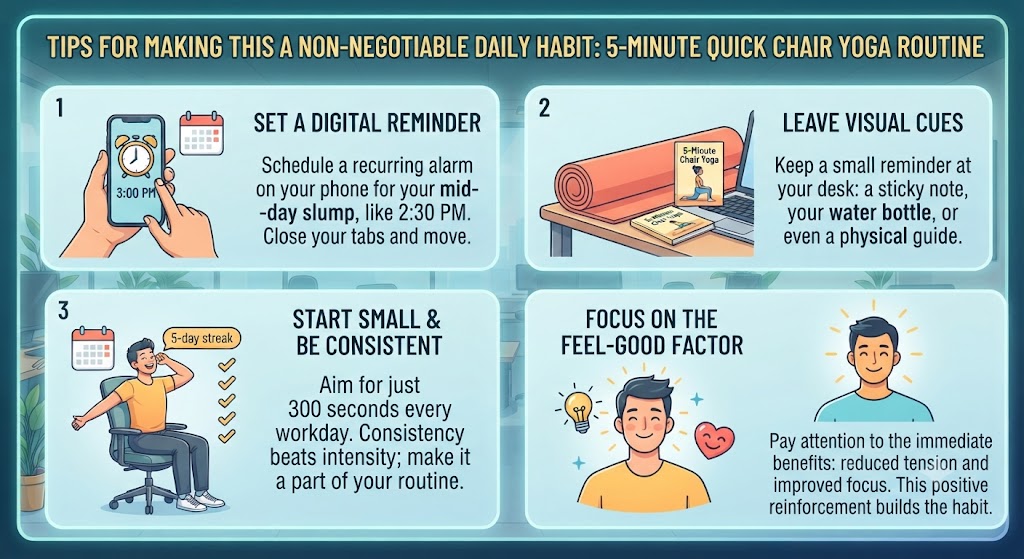
Knowing what to do is only half the battle; consistency is what actually transforms your physical well-being. Over the years, I’ve found a few simple tricks that make sticking to this routine effortless:
- Set a Digital Reminder: Put a recurring alarm on your phone or calendar for 2:30 PM every single workday labeled “Move.” When it rings, close your tabs for five minutes.
- Don’t Overcomplicate It: You don’t need special workout gear. Do it in your work clothes, right at your desk.
- Focus on Breath: The magic isn’t just in the physical shape; it’s in the synchronization of your breath with movement. That is what separates yoga from standard stretching.
Final Thoughts
Taking care office chair mobility of your body doesn’t require a radical lifestyle overhaul or hours of free time that you simply don’t have. By committing just 300 seconds of your day to a 5-minute quick chair yoga routine, you are choosing long-term comfort over chronic stiffness.
Give this sequence a try tomorrow afternoon when that mid-day slump hits hardest. Listen to your body, move with intention, and watch how a tiny adjustment to your routine can completely change the quality of your workday.
Frequently Asked Questions (FAQs)
Q1: Kya chair yoga sach mein posture sudharne mein madad karta hai? Ans: Haan, bilkul! Jab aap din bhar desk par baithte hain, toh aapka spine aur shoulders jhukne lagte hain. Ek regular 5-minute quick chair yoga routine aapke chest ko open karti hai, spine ko align karti hai aur back muscles ko stretch karke posture ko naturally improve karti hai.
Q2: Kya yeh desk yoga stretches office mein bina kisi equipment ke kiye ja sakte hain? Ans: Bilkul. In desk yoga stretches ke liye aapko kisi bhi yoga mat, special gear ya extra space ki zaroorat nahi hoti. Aap ise apne normal office chair par baithe-baithe bina kisi hesitation ke kar sakte hain.
Q3: Din mein yeh chair yoga routine kitni baar karni chahiye? Ans: Aap ise din mein 1 se 2 baar kar sakte hain—jaise subah kaam shuru karne se pehle ya dopahar mein jab aapko 3:00 PM wala mid-day slump ya thakan mehsoos ho. Yeh aapki energy ko turant boost kar deta hai.
Q4: Kya senior citizens ya beginner log bhi office chair mobility exercises kar sakte hain? Ans: Ji haan, chair yoga sabse safe forms mein se ek hai. Agar aapko zameen par baithne mein problem hoti hai ya aapki mobility thodi kam hai, toh office chair mobility movements aapke joints ko safe tarike se flexible aur active rakhne mein madad karte hain.
1 thought on “5-Minute Quick Chair Yoga Routine: Boost Your Energy at Your Desk”